Feature
The Veyron: Has the Market Got This One Wrong?
I think the Bugatti Veyron might be one of the most undervalued important cars of the last 25 years, sounds ridiculous but hear me out...
October 7, 2026
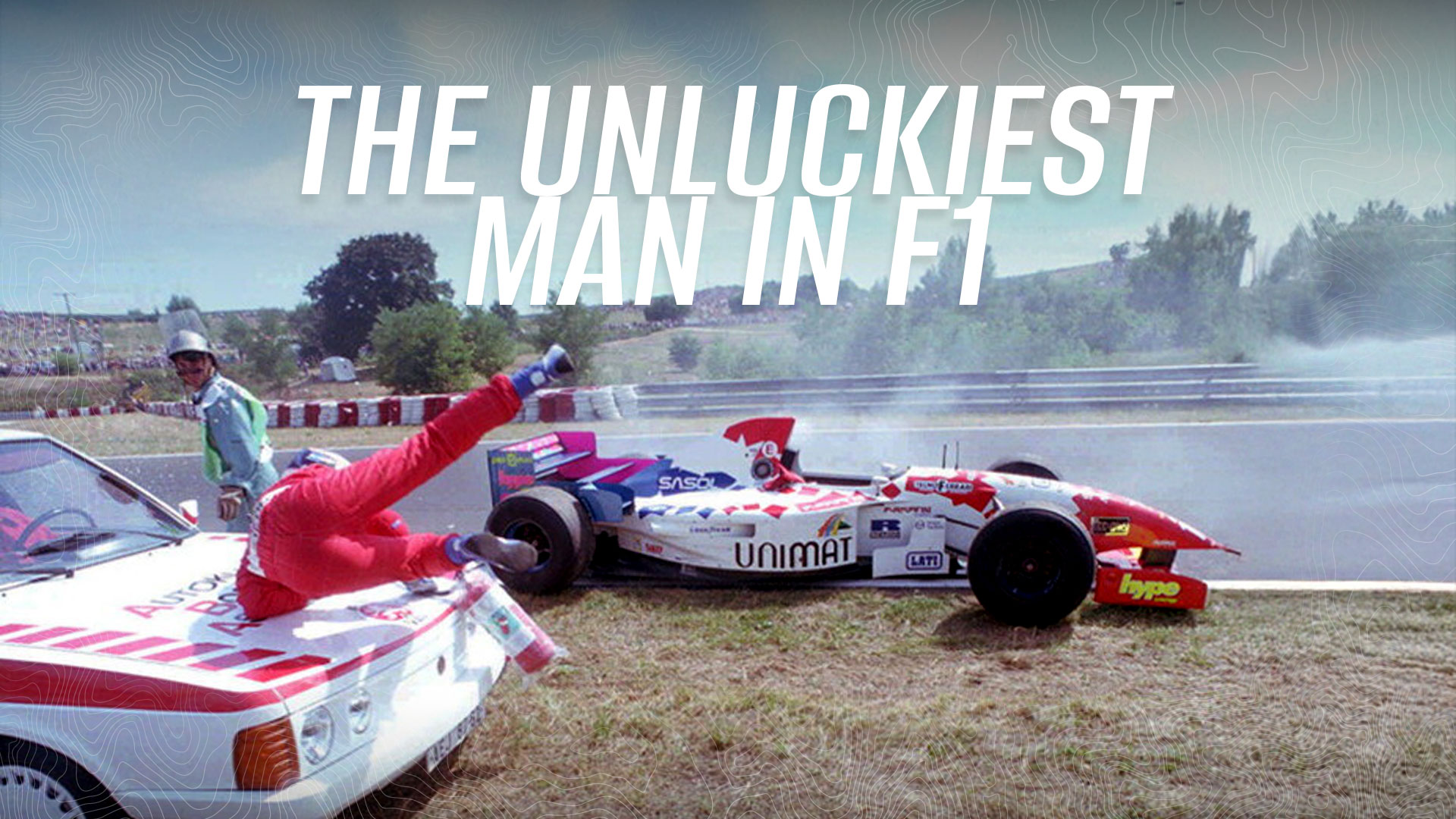
Today we celebrate the most gloriously hapless subplot in grand prix folklore — the Formula One career of Taki Inoue.
Right, gather round. Today we celebrate the most gloriously hapless subplot in grand prix folklore — the Formula One career of Taki Inoue. Not because of poles, podiums or heroic overtakes. No. Because this is the story of a man who treated F1 like an escape room where every clue was a banana skin, and every door led to another fire extinguisher.
He wasn’t slow by accident. He was slow with conviction. He arrived in F1 via the usual ladder — junior single-seaters, a season of F3000, then a one-off with Simtek in 1994 — and you’d think that would furnish a driver with momentum, or at least a working relationship with a chequered flag. What it actually furnished him with was a pitiless statistics sheet and a permanent reservation at the back of the grid. Across 18 starts he scored zero points and collected DNFs like they were hotel soaps.
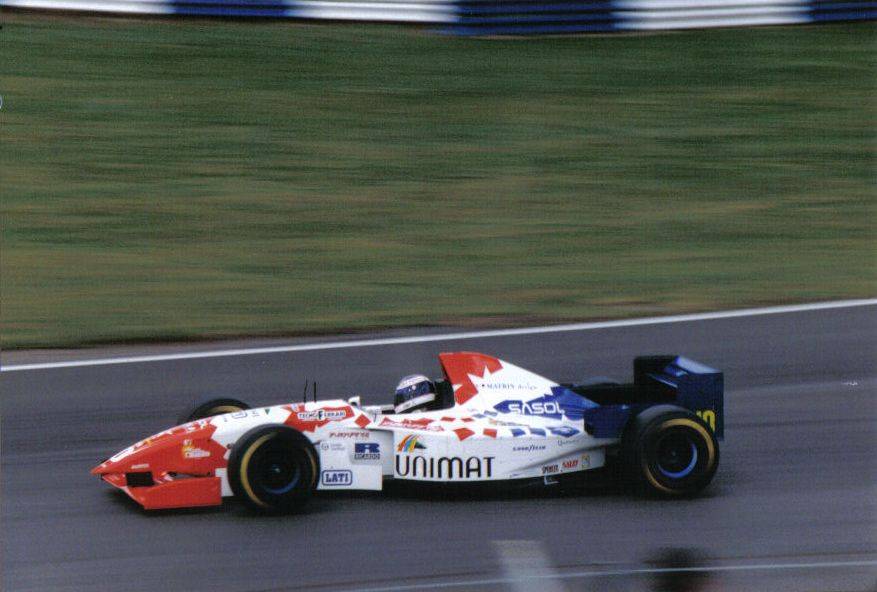
Still, there’s a kind of nobility in showing up. 1995, Footwork Arrows FA16, a Hart V8 that sounded urgent but thoughtful, like a librarian running for a bus. Inoue’s team-mates were Gianni Morbidelli and later Max Papis — both competent, sometimes quick, always pointing in the same direction as the circuit. Taki, by contrast, was like a satnav set to “scenic”. Best results? Ninth in Canada, eighth in Italy, both outside the points at the time, which is a bit like finishing a marathon and finding out the finish line moved to another country.
But here’s the thing. If Formula One were just about lap times, we’d only remember the people who win. The sport isn’t a spreadsheet. It’s theatre. And Inoue, bless him, had perfect comic timing.
Qualifying weekends were his specialty. Not the bit with tyres and apexes. The bit afterwards. At Monaco in ’95 his car stalled and needed towing home. A mundane, bureaucratic little errand. Nothing could possibly go wrong, except everything did. As the Footwork trundled away behind a truck, a course car appeared and did what modern art critics call “a statement”. The tow, the racer, the barriers — it was a traffic calamari salad. Inoue’s car flipped. His helmet was squashed like a crème brûlée under a mallet. If he hadn’t put the lid back on moments before, we’d be discussing him in hushed tones. Instead, he walked away concussed and ready to race on Sunday — which is either courage or Stockholm syndrome by way of Monte Carlo.
This was not the moment that made him legend. That was merely the overture. The universe had a sequel planned, and the universe, it turns out, loves slapstick.
Proper grand prix driving is about managing chaos — temperatures, brake bias, tyre wear, fuel load, and the occasional lunatic from Benetton arriving in your mirrors at warp nine. The best drivers surf that chaos. Inoue did not surf it. He set out a deckchair and hoped the tide would show mercy.
On pace alone, his career would have faded into the fog with many a journeyman’s. But motorsport sometimes gifts a character a single, perfect motif — a calling card so absurd it tattooed itself on history. Inoue’s motif arrived at the Hungarian Grand Prix in 1995 — and it arrived at speed.
He’d retired from the race with an engine fire. Out he hopped, the sort of brisk, purposeful hop that says “I’ve got this". He grabbed a fire bottle from a marshal like a man borrowing sugar, trotted back toward the smouldering Footwork and prepared to play firefighter. What happened next is both tragic and funny, like a custard pie dropped on a Stradivarius. The medical car pulled up. Directly. Into. Taki. There was a thump, a brief flight, a land, and a collective intake of breath heard from Budapest to Bognor. He suffered bruising to his legs and — much later — a global reputation for being the only F1 driver ever to be run over by the medical car. Twice. In one season. By safety and medical cars. The man achieved a double that no champion has matched.
You can watch the Hungarian clip in grainy glory — a brave, slightly exasperated racing driver trying to help, and fate arriving in the form of a Tatra V8 with all the delicacy of a wardrobe down a staircase. How unlucky do you have to be to retire with an engine fire and then be physically assaulted by the cure? You almost expect the marshals to apologise on behalf of Newton’s laws.
And that’s where Inoue becomes, oddly, endearing. F1 is usually a tale told by the victorious. Yet here’s a man whose most famous moments were uncooperative machinery and municipal vehicles with questionable spatial awareness — and he’s taken it with a grin. Years later he’s been wonderfully self-mocking about it, leaning into the folklore like the world’s least likely superhero: Safety-Car-Man, able to stop traffic with his shins. He even jokes about being the worst F1 driver, which is patently unfair. The worst F1 driver doesn’t make you remember him.

Let’s give him his due. Monaco’s flip could have been catastrophic. He kept his helmet on and lived to be the punchline — which is vastly preferable to the alternative. He finished eighth at Monza when points only went to six, and in Montreal he dragged that Footwork to ninth against a retirement list as long as a French lunch. He also kept turning up, week after week, to wrestle a mid-grid car around circuits where even the air has teeth. That takes nerve. Not talent at the level of Schumacher, but nerve like piano wire.
Inoue humanises the sport. F1 sells perfection — carbon-twill gods flinging telemetry at the horizon — but the rest of us live in a world of pratfalls. Taki is our ambassador. He reminds you that behind the corporate sheen there’s still room for farce, that every paddock full of laser scanners and briefcases also contains one bloke who’ll accidentally discover the top speed of a course car using his kneecaps.
F1 drivers are often called superhuman. Taki Inoue proves they’re human-human. He didn’t create victories; he created stories. He gave us a reason to smile, a reminder that the sport isn’t just about perfection — it’s about personality, absurdity, and people daft enough to love it anyway.
The record books say zero points, eighteen starts, and two unfortunate collisions with the same medical service. But the legend says something far better — that he turned bad luck into folklore.
Here’s to him — the man who made us laugh, then wince, then laugh again. The only driver who can walk into a dinner party and say, “I was run over by the medical car... twice", and have everyone believe him.
Taki Inoue: slower than the front runners, quicker than the safety car to the punchline, and proof that even in Formula One, comedy sometimes beats victory.
Written by: Paul Pearce